Home
/ How To Find Equation Of Asymptotes From A Graph : Start by graphing the equation of the asymptote on a separate expression line.
How To Find Equation Of Asymptotes From A Graph : Start by graphing the equation of the asymptote on a separate expression line.
How To Find Equation Of Asymptotes From A Graph : Start by graphing the equation of the asymptote on a separate expression line.. Draw the line alongside the graph of the polynomial. A straight line on a graph that represents a limit for a given function. By the way, this relationship — between an improper rational function, its associated polynomial, and the graph — holds true regardless of the difference in the degrees of the numerator and denominator. 👉 learn how to find the vertical/horizontal asymptotes of a function. As x approaches positive infinity, y gets really.
Keeping these techniques in mind, oblique asymptotes will start to seem much less mysterious on the ap exam! An asymptote is a line that the graph of a function approaches but never touches. The cases are mentioned below: Here x = 3 is a vertical asymptote. A vertical asymptote is a vertical line at the x value for which the denominator will equal to zero.
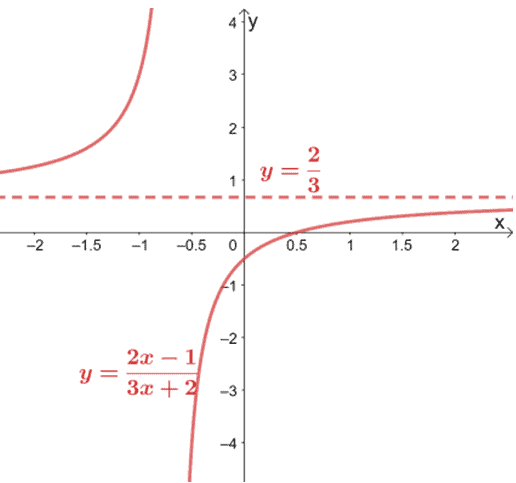
Horizontal Asymptote Properties Graphs And Examples from www.storyofmathematics.com Vertical asymptotes can be found by solving the equation n (x) = 0 where n (x) is the denominator of the function (note: Enter the function you want to find the asymptotes for into the editor. The cases are mentioned below: To sketch the graph of the secant function, follow these steps: There are separate methods for finding vertical, horizontal, and slant asymptotes. 👉 learn how to graph a rational function. A vertical asymptote is a vertical line at the x value for which the denominator will equal to zero. In the example above, you would need to graph x + 2 to see that the line moves alongside the graph of your polynomial but never touches it, as shown below.
The asymptote calculator takes a function and calculates all asymptotes and also graphs the function.
Imagine a curve that comes closer and closer to a line without actually crossing it. Start by graphing the equation of the asymptote on a separate expression line. Determine the horizontal asymptote of the graph. Determining vertical asymptotes from the graph. Vertical asymptotes can be found by solving the equation n (x) = 0 where n (x) is the denominator of the function (note: The function \(y=\frac{1}{x}\) is a very simple asymptotic function. The equation for the slant asymptote is the polynomial part of the rational that you get after doing the long division. A vertical asymptote is a vertical line at the x value for which the denominator will equal to zero. Y = x 2 4 x 2 = 1 4. Enter the function you want to find the asymptotes for into the editor. We have a function that contains a square root term and a linear term. So, f (x) = 1 x − 4 + 1 = x − 3 x − 4 is almost the same as your graph. A graph showing a function with two asymptotes.
Three types of asymptotes are possible: Other kinds of hyperbolas also have standard formulas defining their asymptotes. To find the slant asymptote: Y = x 2 4 x 2 = 1 4. So, f (x) = 1 x − 4 + 1 = x − 3 x − 4 is almost the same as your graph.
Find Equation For A Hyperbola Without Asymptote Mathematics Stack Exchange from i.stack.imgur.com A straight line on a graph that represents a limit for a given function. The vertical asymptotes of a rational function may be found by examining the factors of the denominator that are not common to the factors in the numerator. When we set them equal to zero. To graph asymptotes, it is necessary to find them first. Reduce the expression by canceling common factors in the numerator and the denominator. If you get a valid answer, that is where the function intersects the horizontal asymptote, but if you get a nonsense answer, the function never crosses the horizontal asymptote. 👉 learn how to graph a rational function. Imagine a curve that comes closer and closer to a line without actually crossing it.
The vertical asymptotes of a rational function may be found by examining the factors of the denominator that are not common to the factors in the numerator.
If you get a valid answer, that is where the function intersects the horizontal asymptote, but if you get a nonsense answer, the function never crosses the horizontal asymptote. When we set them equal to zero. Y = x 2 4 x 2 = 1 4. A sketch of the cosine function. Find the slope of the asymptotes. So, f (x) = 1 x − 4 + 1 = x − 3 x − 4 is almost the same as your graph. Also, although the graph of a rational function may have many vertical asymptotes, the graph will have at most one horizontal (or slant) asymptote. 👉 learn how to find the vertical/horizontal asymptotes of a function. Find the equation of vertical asymptote of the graph of f(x) = 1 / (x + 6) solution : To find horizontal asymptotes, we may write the function in the form of y=. An asymptote is a line that the graph of a function approaches but never touches. The graph moved 4 units to the right and 1 unit up. 👉 learn how to graph a rational function.
This determines the vertical translation from the simplest exponential function, giving us the value of {eq} {\color {orange} k} {/eq}. The asymptote calculator takes a function and calculates all asymptotes and also graphs the function. Graph your line to verify that it is actually an asymptote. Reduce the expression by canceling common factors in the numerator and the denominator. The hyperbola is vertical so the slope of the asymptotes is.
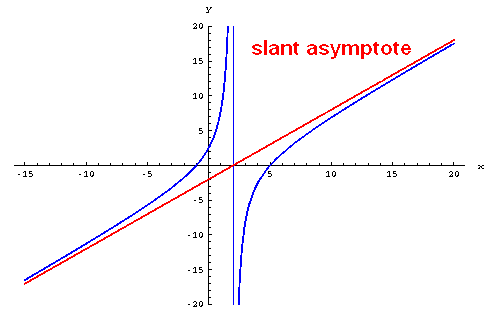
How To Find Slant Asymptote Of A Function from www.onlinemath4all.com The vertical asymptotes of a rational function may be found by examining the factors of the denominator that are not common to the factors in the numerator. This determines the vertical translation from the simplest exponential function, giving us the value of {eq} {\color {orange} k} {/eq}. The style menu will appear. When we set them equal to zero. In the meantime, it's possible to create an asymptote manually. An asymptote is a line that the graph of a function approaches but never touches. If you get a valid answer, that is where the function intersects the horizontal asymptote, but if you get a nonsense answer, the function never crosses the horizontal asymptote. Find any asymptotes of a function definition of asymptote:
In the example above, you would need to graph x + 2 to see that the line moves alongside the graph of your polynomial but never touches it, as shown below.
Enter the function you want to find the asymptotes for into the editor. Graph your line to verify that it is actually an asymptote. Draw the line alongside the graph of the polynomial. A sketch of the cosine function. Factor the numerator and denominator of (). There are two main ways to find vertical asymptotes for problems on the ap calculus ab exam, graphically (from the graph itself) and analytically (from the equation for a function). Start by graphing the equation of the asymptote on a separate expression line. If you get a valid answer, that is where the function intersects the horizontal asymptote, but if you get a nonsense answer, the function never crosses the horizontal asymptote. Find the equation of vertical asymptote of the graph of f(x) = 1 / (x + 6) solution : F (x) + 3 is a translation of that graph by 3 units in the positive y directive i.e. By the way, this relationship — between an improper rational function, its associated polynomial, and the graph — holds true regardless of the difference in the degrees of the numerator and denominator. 👉 learn how to graph a rational function. For repeating asymptotes, try using lists to save time.
(see next section) multiply the numerator and denominator back in to polynomials if necessary and then divide the remaining numerator by the remaining denominator (ie how to find equation of asymptote. Identify and reduce any holes*.